 GLP1 Math
GLP-1 cost calculator: whole fills, fees, and a realistic yearly budget
Use your actual out-of-pocket quote to estimate cash outlay. The calculation separates medication fills from membership bills and explains why 52 weeks and a calendar year can produce different totals.
Last editorially updated: · By Jeff Schaeffer
Not medical advice. Talk to your prescriber and pharmacist. Confirm your prescribed dose, product, concentration, device, and instructions before using any calculation. This website cannot choose or change your treatment.
Build a budget from your actual quote
No current medication price is assumed. Enter zero only when an item really costs you nothing.
— whole fills
— planned cash outlay
— average per calendar month
Assumes no usable starting inventory and a constant fill price.
How this is calculated: every formula is written out on this page, the sources are listed at the bottom, and our editorial policy explains how we check and correct numbers.
Comparing GLP-1 program costs?
Use your actual provider quote to estimate the full cost with our cost calculator. You can also review pricing and eligibility directly with a telehealth provider.
SkinnyRxOral and injectable GLP-1 options, with financing.See SkinnyRx options →Disclosure: GLP1 Math may earn a commission if you sign up through these links. It costs you nothing extra and does not change what the calculators show. A provider listing is not a medical recommendation.
A budget needs a price and a time unit
A quote described as monthly is incomplete unless you know what one payment buys. It might cover four weekly doses, thirty days of medicine, a calendar month of access to a clinician, or a subscription with separate dispensing charges. Those are different products from a budgeting perspective. Before comparing providers, write down the net medication charge, covered treatment days, delivery fees, membership terms, and any required visits or tests. Enter only confirmed numbers. This calculator intentionally contains no assumed retail price, coupon value, or insurance benefit.
The medication input should be the amount you actually expect to pay after an eligible discount. Do not subtract the same discount again elsewhere. If a savings offer is conditional, keep an undiscounted scenario as well. The output is an arithmetic estimate based on your entries, not a price quote or a coverage determination. A pharmacy, insurer, or program must confirm the billable terms. The annual cost guide gives a worksheet for gathering those terms before doing the calculation.
Why the tool rounds fills upward
You generally buy whole fills rather than a fraction of a future prescription. The model therefore uses whole fills = ceiling(planning days ÷ days per fill), assuming no usable starting inventory. Medication cash outlay is whole fills multiplied by your entered net price. The ceiling operation rounds any incomplete final fill up to one purchase. This differs from an average consumption model that multiplies a daily price by days and may understate the amount of money you actually need at the pharmacy.
For 364 planning days and 28 days per fill, the result is exactly 13 fills. For 365 planning days under the same continuous-coverage assumption, the result is 14 fills because 13 times 28 covers 364 days. That does not mean every person's bank account will show fourteen medication charges in every calendar year. Starting stock, first purchase date, weekly injection dates, insurer timing, and the chosen end date all matter. The tool labels its assumption so you can distinguish an estimate from a transaction calendar.
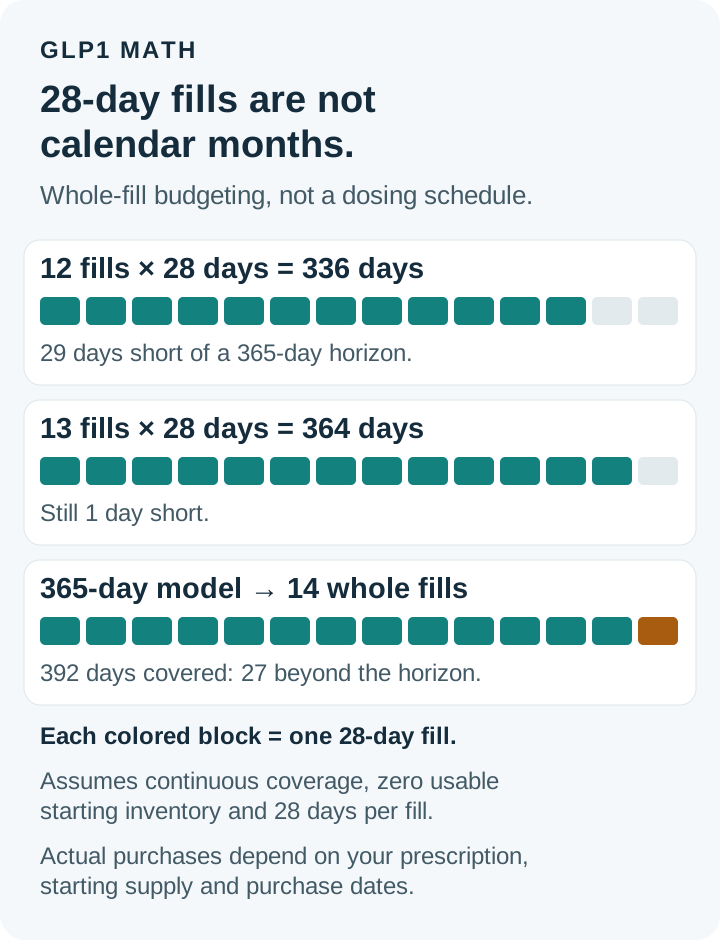
Illustration assumes continuous coverage, zero usable starting inventory and 28 days per fill. Actual purchases depend on the prescription, starting supply and purchase dates. This is whole-fill budgeting, not a dosing schedule.
The familiar thirteenth-fill issue
Fifty-two weeks contains 364 days. Four-week supplies divide into that period thirteen times, while twelve calendar-month membership payments may occur during the same budget year. Multiplying a four-week medication charge by twelve leaves four weeks uncovered in a 52-week model. The missing amount is one additional medication fill at your actual price, not an extra membership bill by definition. Programs can bill membership differently, so count those bills from the contract rather than copying the fill count.
Use algebra when you do not yet have a quote: if the net fill price is P and the monthly membership is M, a 52-week plan with 28-day fills and twelve membership bills costs 13P + 12M before other expenses. This avoids presenting an invented dollar amount as a market price. Once you have written quotes, substitute the verified values. Compare the total expression across options rather than comparing a large advertised discount against an unrelated provider's undiscounted headline.
Membership and extras remain separate inputs
The calculator asks for both the monthly membership charge and the number of bills expected in the selected horizon. That makes the assumption visible. A twelve-month commitment, a cancel-anytime arrangement, and a membership paused during a supply interruption can have different cash consequences even when their monthly rates match. Use the number specified by your agreement. Do not assume a missed injection automatically pauses billing or that stopping treatment cancels a contract. Those are operational questions for the provider.
The extras input is a total for the entire planning period, not a monthly amount. Include confirmed visits, laboratory charges, delivery, syringes, swabs, and a sharps container if you pay separately. Avoid counting an included item twice. If an expense is unknown, record it outside the calculation as unresolved instead of pretending zero is a verified quote. A transparent incomplete estimate is more useful than a precise total built from assumptions that cannot be checked.
Average monthly cost is not the monthly bill
The total combines medication purchases, membership bills, and extras. To provide a common comparison scale, average calendar-month cost equals the total divided by planning days and multiplied by 365/12. That normalized number helps compare plans with different horizons. It is not a promise that each actual month costs that amount. A refill date can drift across month boundaries, producing two charges in one month and one in another. Upfront supplies or annual visits can make the cash pattern uneven as well.
For an exact payment calendar, use the year-of-fills guide. List actual purchase dates and any initial inventory. Count charges falling within a defined start and end date, then reconcile the quantities with the prescription and pharmacy's refill rules. Do not buy medicine early or change injection spacing merely to force a spreadsheet pattern. Budgeting should reflect the clinical plan; it should not dictate the dose or schedule.
Changes during the year need a second scenario
This simple tool assumes a constant net fill price and a constant days supply. If the pharmacy quote changes with product, presentation, insurance stage, or prescribed amount, calculate each stable period separately and add the cash totals. A starter package may also cover a different number of weeks from a maintenance package. Read the actual quantity and directions instead of assuming every box lasts four weeks. A medication change should be confirmed by the prescriber before any cost comparison is treated as actionable.
An insurance estimate can change at a deductible reset, renewal, prior-authorization decision, or benefit limit. Ask the insurer for the exact product, presentation, quantity, and diagnosis-related coverage criteria rather than asking whether all GLP-1 medicines are covered. Record the date of the quote and the source. This page does not rank insurers or make eligibility claims. It provides a consistent arithmetic framework for comparing information that the relevant organization has supplied to you.
Waste and storage can affect usable supply
A vial's total mg does not automatically equal usable treatment weeks. Disposal instructions, storage excursions, beyond-use dates, and presentation-specific limits can prevent all visible liquid from becoming future doses. Ask the pharmacy how many prescribed doses the dispensed package is intended to provide. Do not use remaining liquid after a disposal deadline to reduce the apparent cost per dose. The storage guide explains why a financial estimate must respect the exact product's handling instructions.
Likewise, a missed dose is not automatically a saved weekly expense. Whether to take it late, skip it, or obtain a restart plan depends on the medicine and circumstances. The brand labels use different timing rules, summarized in our missed-dose comparison. A budget cannot choose between those rules. Contact the prescriber about treatment changes and the pharmacy about refill timing. If cost threatens continuity, raise it with them before supply runs out so the plan can be reviewed.
Frequently asked questions
Why is the medication price blank?
The site does not know your pharmacy quote, insurance benefit, or eligibility for a savings offer. Enter the actual net price you have verified. Zero is appropriate only when the fill truly has no out-of-pocket charge for you.
Why can 365 days show fourteen 28-day fills?
The tool models continuous day coverage from no starting stock and purchases whole fills. Thirteen fills cover 364 days, leaving one day in that model. An actual weekly injection and purchase calendar can differ; count real dates for cash-flow planning.
Does it subtract a savings card automatically?
No. Enter the net charge after a confirmed eligible discount. Automatic subtraction could double-count a discount already included in the quote or assume eligibility the site cannot establish. Keep a second scenario if the benefit could expire.
What belongs in extras?
Use the total separately payable visits, tests, shipping, supplies, and other confirmed costs for the selected period. Do not enter a monthly amount unless you have first multiplied it by the number of payments, and do not duplicate costs included in a membership.
Can it compare different medications?
It can compare their verified financial terms using separate runs, but a cheaper arithmetic result does not establish clinical suitability or dose equivalence. A prescriber must decide whether a product change is appropriate.
Is the monthly average what I will be charged?
No. It normalizes total cash outlay to a calendar-month scale for comparison. Actual charges follow pharmacy purchases, membership bills, and other payment dates. A refill calendar is necessary to see months with unusually high outlay.